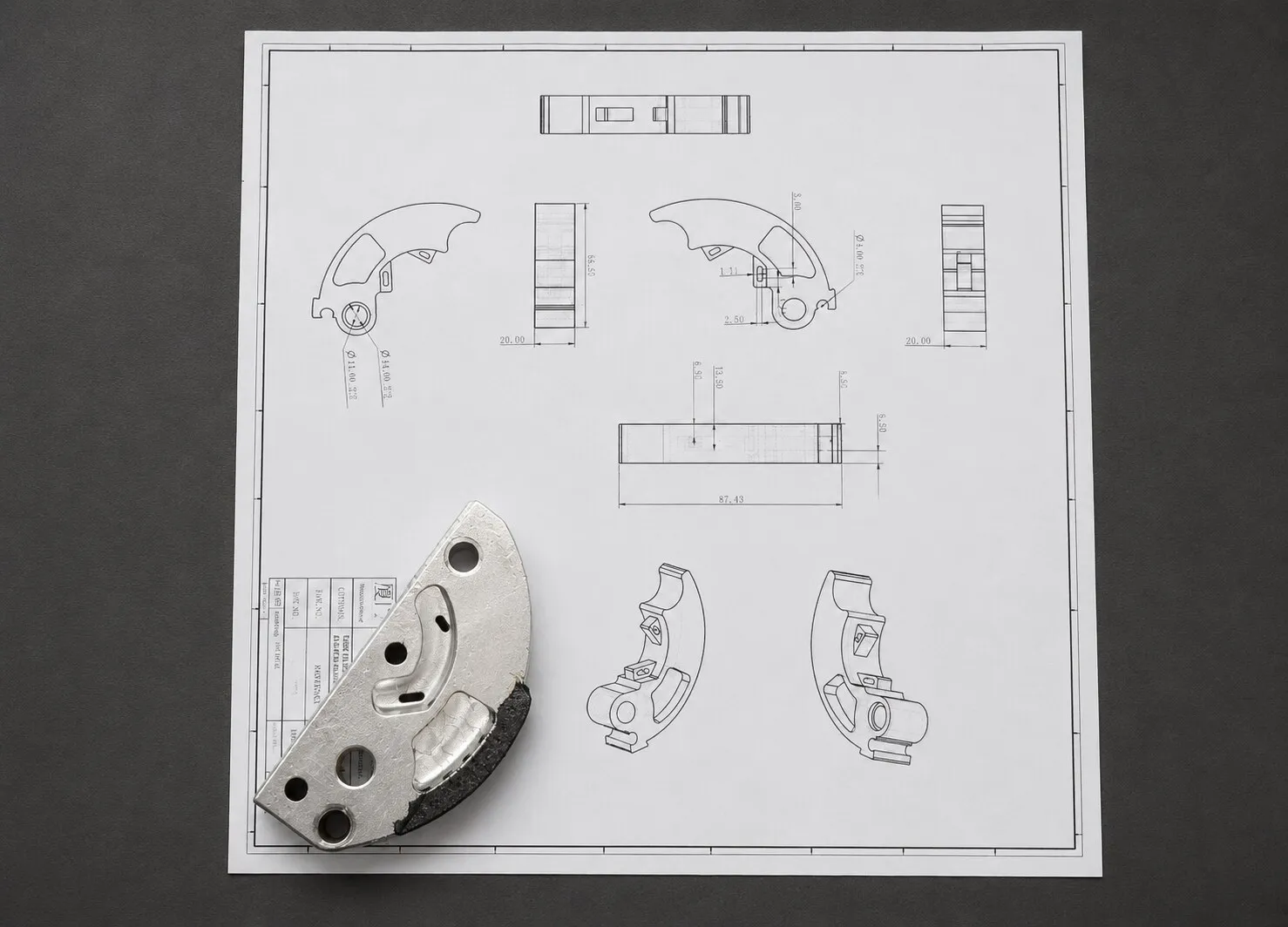
Two suppliers can quote the same CAD model at very different prices because they are pricing different assumptions. Material condition, tolerances, finishing, inspection, quantity, packaging, and delivery responsibility all change the scope of a CNC machining project.
A complete CNC machining RFQ normally includes the current 3D CAD model, a controlled 2D drawing where one is required, part and revision identification, material and condition, quantity, tolerances and critical features, finishing, inspection and documentation requirements, and the delivery or quotation scope. Exactly which of those apply depends on how the product definition is controlled. The goal is not to send the most files — it is to make clear what defines the part, what the supplier has to include, and how the finished parts will be accepted.
In This Article
- What the model, drawing, and RFQ each control
- How to control files and revisions
- What manufacturing and finishing details to specify
- What inspection evidence to request
- Which omissions delay or distort a quote
- The final RFQ checklist
Why a CAD File Alone May Not Define the Quote
A solid model describes nominal shape. It does not identify the released revision, the material condition, the functional tolerances, the finish, the inspection records, or the delivery requirements.
Take a simple housing model. One supplier prices readily available aluminum, its own internal dimensional verification, and no finish. Another prices a specified temper, anodizing with masked bores, an inspection report, individual part protection, and international delivery. Both quotations are reasonable. Neither is comparable to the other.
An RFQ therefore has to establish four boundaries:
- Product definition: which model, drawing, dataset, configuration, and revision control the part.
- Manufacturing requirements: which material, tolerances, threads, edges, heat treatments, and finishes apply.
- Acceptance requirements: what must be inspected, documented, certified, or visually accepted.
- Commercial scope: what quantity, tooling, packaging, schedule, freight, and delivery basis are included.
Leave one of them open and the supplier should be naming the assumption in the quotation.
What Belongs in the 3D Model, Drawing, and RFQ
The 3D model, the controlled drawing, and the commercial documents work together. Their authority still has to be stated — none of them overrides the others by default.
| Document | Primary purpose | Typical information | Do not assume it contains | Risk if missing or conflicting |
|---|---|---|---|---|
| 3D model | Define nominal geometry | Solid shape, complex surfaces, sometimes PMI | Complete tolerances, material, finish, inspection, or commercial scope | Wrong or incomplete geometry may be quoted |
| Controlled 2D drawing | Define technical requirements not otherwise controlled | Tolerances, datums, threads, notes, material, finish, revision | Every nominal dimension, where an authoritative model controls geometry | Acceptance requirements may remain unclear |
| RFQ and purchase documents | Define requested quantity and the quotation or order boundary | Active file list, quantity, delivery, documents, packaging, assumptions | Geometry or drawing requirements not expressly incorporated | Quotations may cover different work |
Choose a usable CAD format
A validated solid model is usually the most useful source for CNC geometry because it supports interrogation, sectioning, measurement, and CAM preparation. STEP is widely used for neutral mechanical-data exchange. An agreed kernel-based format such as Parasolid XT, or a native CAD file, also works when it matches the sending and receiving systems — though native files can depend on a particular software release or add-in.
No format guarantees identical interpretation across every CAD and CAM workflow, so translation should be checked at the receiving end.
ISO 10303-242:2025, commonly known as STEP AP242, covers managed model-based 3D engineering, with geometry, configuration, PMI, and related product data in scope. That does not mean every STEP file is AP242, or that every AP242 file carries all supported data. The application protocol, implementation, export settings, and receiving software decide what actually transfers.
STL is a different animal. A conventional STL holds a tessellated triangular mesh rather than the original analytic or parametric geometry, and it declares neither authoritative units nor the controlled manufacturing requirements needed for acceptance. It remains useful for visualization, limited preliminary quotation, or noncritical work. For precision CNC product definition it is a poor controlling source unless both parties agree on its limitations and the missing requirements arrive some other way.
Use a drawing or a controlled MBD dataset for acceptance requirements
A controlled CNC machining drawing usually communicates:
- dimensional and geometric tolerances, datums, fits, threads, and inserts;
- material, temper or condition, product form, and heat treatment;
- surface texture, edge requirements, finish, masking, and notes;
- inspection, documentation, units, drawing standard, and revision.
Not every part needs a fully dimensioned 2D drawing. A controlled model-based definition dataset can serve as the product definition when authority, annotations, standards, software workflow, and revision are agreed. The authoritative data has to stay accessible and readable through quotation, manufacturing, and inspection — not only on the day the RFQ arrives.
ISO 16792:2021 supports both model-only and model-with-drawing methods. ASME Y14.41-2026 addresses digital product-definition datasets within the ASME framework. A customer contract may invoke a different edition, so identify the applicable system rather than leaving it to be inferred.
Define the Controlling File and Revision
State whether authority sits with the drawing, the model, the MBD dataset, or a defined combination. There is no universal rule that the drawing always overrides the model.
A package might state that the model controls untoleranced geometry while the drawing controls tolerances, material, notes, and finishing. That works when it is explicit and internally consistent. A supplier may issue a conditional quotation based on a documented interpretation, but conflicts and deviations have to be resolved or formally accepted in the approved technical package before production is authorized.
Tie the request and the order to controlled identifiers, as applicable:
- part number, drawing number, CAD filename, configuration, and active revision;
- buyer RFQ or requisition, and supplier quotation number and revision;
- quantity associated with each part revision;
- purchase-order revision and supplier order acknowledgement;
- approved file manifest, clarifications, and deviations.
Names such as final, final-new, and latest are not release control. Exclude or clearly segregate superseded files from the active package, while retaining whatever records your document-control procedure requires.
State the controlling units, and verify model units on import. If both inch and metric dimensions appear, identify which system controls. Review feature-specific callouts, general notes, title-block defaults, and referenced standards together rather than assuming a hierarchy the product definition never established.
ASME Y14.5-2018 (R2024) and the ISO GPS system, including ISO 1101:2017, use related concepts with different defaults and interpretation rules. State the governing system and edition instead of mixing conventions.
Specify Material, Quantity, and Production Context
“Aluminum” and “stainless steel” name material families, not purchasing requirements. Specify the alloy or grade and, where relevant, the temper, heat-treatment condition, hardness, or delivery condition. Product form may also be controlled: plate, bar, extrusion, forging, and casting differ in availability, properties, material direction, stock allowance, and certification route. Our materials pages list what we work with most often.
State whether substitutions are prohibited, permitted, or subject to written approval. Similar-looking designations from ASTM, AMS, EN, DIN, ISO, or national systems are not automatically equivalent. If a material certificate, heat or lot traceability, or customer-supplied material is required, put that in the RFQ.
Quantity shapes the manufacturing plan. Identify prototype quantity, initial batch, expected repeat quantity, and realistic annual demand where you know it, and consider asking for quantity breaks when future demand is uncertain.
A prototype may use simple or modular workholding and extensive first-piece verification. A recurring order justifies dedicated fixtures, different material purchasing, a revised inspection plan, or different packaging. Requesting pricing against speculative volumes that will not be ordered helps nobody.
Identify Functional and Critical Features
Mark the features that control fit, location, alignment, sealing, rotation, assembly, safety, electrical contact, fluid flow, or contractually defined appearance, and provide the mating part or interface information wherever the relationship matters.
Identifying critical-to-quality features helps the supplier plan manufacturing and inspection. It does not replace the complete product definition, relax other requirements, or imply that every CTQ needs the narrowest possible tolerance. General tolerances can cover eligible noncritical dimensions; feature-specific controls should follow function.
Keep this concise in the RFQ. For the underlying decisions, see which CNC machining features actually need tight tolerances.
Define Threads, Finishes, and Edge Requirements
Threads and inserts
A thread callout may need the applicable thread standard and system, nominal size, pitch or threads per inch, class or tolerance designation, depth or through condition, and any nonstandard handedness. In blind holes, distinguish required usable full-thread depth from drill or tool depth — they are not the same number.
For inserts, identify the insert system, size, locations, and applicable installation and acceptance requirements. State whether threads are accepted before or after coating, which areas are masked, and whether post-finish thread work is permitted. Thread galling in stainless parts covers what else that decision affects.
Surface texture and edges
Specify surface texture only where function or contractual acceptance requires it. A roughness parameter does not by itself define scratches, visual quality, flatness, or every aspect of texture such as lay and waviness. Under the ISO framework, ISO 21920-1:2021 addresses the indication of profile surface texture in technical product documentation.
“Deburr all edges” covers general handling and not much else. Identify seal-entry edges, functional chamfers and radii, mating edges, flow features, and any edge that has to stay controlled. A single universal edge break can quietly change fit, wall thickness, sealing, or appearance.
Finishing and special processes
Keep the process categories distinct in the technical package:
- material heat treatment or hardness condition;
- mechanical preparation such as bead blasting;
- anodic, conversion, passivation, plating, or electropolishing treatment;
- paint or powder-coat system.
Specify the applicable process or standard, controlled areas, color or appearance, masking boundaries, rack and electrical-contact restrictions, and approved post-finish machining where it is required. State whether critical dimensions are accepted before or after finishing. Coating thickness is not one universal dimensional-buildup value across anodizing and deposited coatings — how hardcoat anodizing affects tight tolerances works through why. Our surface finishing pages describe each process we coordinate.
Visual terms need a common reference too. “Uniform,” “scratch-free,” “tool-mark free,” “production quality,” and “Class A” produce different decisions in different shops unless the buyer defines acceptance zones, viewing conditions, defect limits, approved samples, color references, or another agreed method.
State Inspection and Documentation Requirements
Inspection scope moves the price. The RFQ should identify what verification is required, what evidence must be delivered, and which characteristics need reporting. Do not rely on “standard inspection” — the quotation should state the internal verification included and whether a separate report comes with it. Our inspection and quality control page sets out how we approach this.
Additional requirements may include a dimensional report, a first-article report, a sampling plan, 100% inspection of selected characteristics, a defined measurement method, or specific datum simulation and part restraint. Ask for these before pricing, not after.
FAI does not automatically mean AS9102. SAE AS9102C is a specific aerospace First Article Inspection framework with its own documentation requirements. Invoke it only when the contract requires it.
Documents provide different evidence, and one does not stand in for another:
- a certificate of conformity declares conformity to the referenced order or specification;
- a material certificate addresses material identity or properties under its stated document type;
- a process certificate addresses a specified special process;
- a dimensional report records results for defined characteristics;
- traceability links delivered parts to applicable lots, heats, processes, or records.
Where measurement method, uncertainty, temperature, datum setup, or restraint could change an acceptance decision, define the applicable conditions and the decision rule. Under ISO GPS, ISO 14253-1:2017 addresses conformity decisions that account for measurement uncertainty; it is not automatically the contractual rule for every drawing.
Clarify Packaging, Delivery, and Quotation Scope
Packaging should match the part and the transport risk. Finished surfaces may need separation; precision fits, sealing surfaces, and threads may need protection; corrosion-sensitive parts may need controlled wrapping or preservation. Add cleanliness, labeling, lot separation, orientation, or export-packaging requirements where they apply.
Define the schedule event you are asking for. A requested ship date differs from a requested arrival date, and neither is manufacturing lead time. The quotation should state the lead-time basis and its start trigger — receipt of an accepted order, an approved technical package, material, or another agreed condition. Transit, customs, finishing, documentation, and partial shipments deserve explicit treatment where they affect the date.
For a comparable commercial scope, identify currency, quotation validity, non-recurring charges, included finishing and inspection, packaging, freight, and the agreed allocation of shipping costs and responsibilities. For international shipments, state the Incoterms® rule, the named place or port, and the version. ICC’s official Incoterms® 2020 overview explains the current rules, which do not replace the sales contract.
Use approved channels and internal procedures for confidential or controlled technical information. Export controls, privacy, licensing, and data residency all need qualified review for the actual data and jurisdictions involved.
Common RFQ Problems That Delay or Distort a Quotation
| Problem | Result |
|---|---|
| Mixed revisions, or several files named “final” | The released configuration is unclear |
| Model and drawing conflict | Geometry, pricing, and inspection may follow different interpretations |
| No quantity or production context | Setup, fixtures, material, and inspection remain assumptions |
| Material grade without condition | Availability, properties, processing, and certification may differ |
| Finish or masking not defined | Routing and finished dimensions cannot be evaluated |
| Incomplete thread callout | Form, class, usable depth, or coating treatment remains unknown |
| Undefined cosmetic requirement | Buyer and supplier apply different visual criteria |
| Inspection documents added after pricing | The quote may not include the required work or records |
| STL supplied as the only product definition | Geometry and acceptance requirements may be ambiguous |
A quotation may carry assumptions, exclusions, proposed deviations, and open questions. Compare those alongside revision, material, quantity, finish, inspection, documentation, tooling, packaging, freight, and schedule basis. Before order release, every open item should be accepted, rejected, or resolved in the approved order package. Why CNC machining quotes vary covers the comparison itself.
CNC Machining Drawing and RFQ Checklist
Part definition
- Part number, configuration, files, and revisions agree.
- The controlling model, drawing, MBD dataset, or defined combination is stated.
- Units, drawing system, standards, and active file manifest are identified.
- The supplier quote and purchase order reference the approved technical package.
Manufacturing requirements
- Material grade, temper or condition, product form, and substitution rules are clear.
- Prototype, batch, repeat, and quantity-break requirements are stated.
- CTQs, mating interfaces, tolerances, threads, inserts, texture, and edges are defined.
- Heat treatment, preparation, finishing, masking, appearance, and post-finish acceptance are specified where applicable.
Quality and documentation
- Included internal verification and required inspection reports are distinguished.
- Sampling, 100% checks, first-article, measurement, and acceptance requirements are stated where applicable.
- Material, conformity, process, and traceability documents are listed by required type.
- All quotation assumptions and deviations are dispositioned before production release.
Commercial and delivery scope
- Requested ship or arrival dates, lead-time trigger, destination, and partial-shipment policy are clear.
- Packaging and part-protection requirements match the product risk.
- Currency, validity, non-recurring costs, freight, taxes, duties, and delivery basis are identified.
- Confidential or controlled data follow the buyer’s approved procedure.
What PURESPEC Reviews Before Quotation
Through its DFM and engineering review, PURESPEC can coordinate review of file completeness, revision consistency, material, quantity, manufacturability questions, identified critical features, finishing, inspection documentation, packaging, and commercial assumptions.
The point of that review is to expose missing or conflicting requirements before production planning and quotation. It does not replace the customer’s design authority, validate product function, or guarantee manufacturability.
A Complete Package Produces a Comparable Quote
A useful CNC machining drawing and RFQ establish the controlling product definition, the manufacturing requirements, the acceptance evidence, and the commercial boundary. Get those four right and a buyer can compare scope instead of guessing at unit price.
Frequently Asked Questions
Do I need both a 3D CAD model and a 2D drawing?
Not always. A model-only definition works when authority, PMI, revision, standards, and receiving workflow are all controlled. Otherwise a drawing is usually the clearest place for tolerances, notes, material, finish, and inspection requirements.
Is a STEP file enough for a CNC machining quote?
Sometimes, for a preliminary quote on a simple part. The supplier still needs material, quantity, tolerance, finish, inspection, and commercial assumptions, and the STEP application protocol and export settings do not guarantee that all PMI or configuration data made it across.
Can I send an STL file for CNC machining?
Yes, but treat it as reference data rather than the sole precision product definition. Confirm units, geometric suitability, tolerances, and acceptance requirements separately.
What inspection information belongs in the RFQ?
State what must be inspected, the sampling or 100% scope, the required report format, certificates, traceability, and any measurement condition that affects acceptance. Also confirm what internal verification is already included in the supplier's price.
What if the CAD model and drawing conflict?
The supplier may quote against a documented assumption, but the conflict has to be resolved or formally accepted before production authorization. The approved order package should record which requirement controls.
References
- ASME Y14.5-2018 (R2024), Dimensioning and Tolerancing
- ASME Y14.41-2026, Digital Product Definition Data Practices
- ISO 16792:2021, Digital product definition data practices
- ISO 10303-242:2025, Managed model-based 3D engineering
- ISO 1101:2017, Geometrical tolerancing
- ISO 21920-1:2021, Indication of profile surface texture
- ISO 14253-1:2017, Decision rules for verifying conformity or nonconformity
- SAE AS9102C, Aerospace First Article Inspection Requirement
- ICC, Incoterms® 2020